Transformers Do Not Stop Transient Overvoltage
Key Takeaways
Transformers don’t block transient overvoltage events. Despite common assumptions, transformers—whether isolation or shielded—do not eliminate transient overvoltage spikes. Due to capacitive and inductive coupling, high-frequency transients pass through transformers with minimal attenuation and can even be amplified.
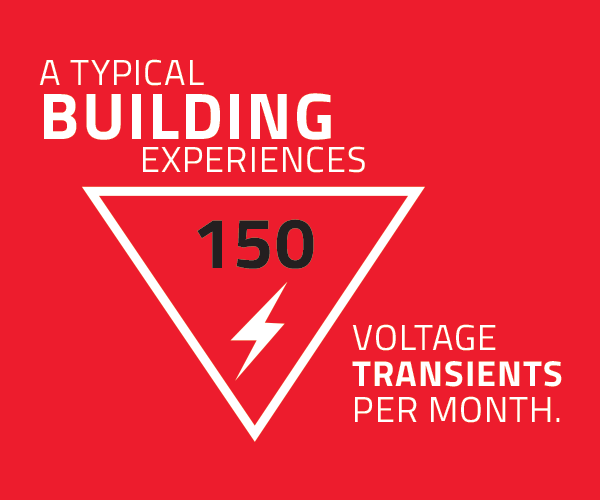
Transients pose serious risks to sensitive equipment. Most facilities experience around 150 transient events per month, which can lead to malfunctions and premature equipment failure, resulting in costly downtime, lost productivity, and hours of troubleshooting.
Mitigating transient overvoltage requires purpose-built transient voltage surge suppressors (TVSS)—also known as surge protective devices (SPDs)—placed strategically throughout the electrical system.

Introduction
Transformers are a staple in electrical systems, stepping voltage up or down as needed. But when it comes to one of the most prevalent power quality threats—transient overvoltage—transformers fall short. Here’s why that matters more than one might think.
Transient Overvoltages Pass Through Transformers
Transient overvoltages are brief, high-frequency, high-energy voltage spikes. They originate from sources like load switching, lightning, and even the normal operation of variable frequency drives (VFDs). Though they last just nanoseconds, they carry enough energy to cause long-term harm.
A common misconception is that transformers inherently filter, block or attenuate these events. While transformers provide galvanic isolation and alter voltage levels, they do not eliminate high-frequency disturbances like transient overvoltage.
Transients are able to bypass a transformer’s magnetic core via:
- Capacitive coupling: According to IEEE 1159-2009 5.5.1, “Impulsive transients can also pass through transformers through the interwiding capacitance and will appear on the low side of the transformer. They are not reduced by the turns ratio. Damage from such transients can also occur on equipment connected to the low side of the transformer.”1
- Inductive coupling: Fast-rising current in the primary winding induces a corresponding voltage in the secondary through mutual inductance.
- Note: Shielding Transformers can help mitigate transient overvoltage on common mode but not differential mode.
Even shielded isolation transformers allow fast transients to propagate downstream, often with minimal attenuation. According to studies, the input and output waveforms of transformers during transient events are nearly identical.2
“When properly applied, isolating power transformers are useful to break ground loops, but they do not by themselves attenuate surges that occur line-to-line or in the normal mode.”

“Figure 8 shows the propagation—or worse, the enhancement—of a voltage impulse in a 1:1 isolating power transformer. The 6 kV impinging ring wave appears as 7 kV crest on the secondary side of this ‘isolating’ transformer.”2
Real-World Impact of Transient Overvoltage
The consequences of transient overvoltage are significant and often underestimated. Transient overvoltage is an unavoidable part of AC power systems, according to IEEE.4 The National Electrical Manufacturers Association (NEMA) reports that a typical building experiences around 150 of these events each month, though their frequency and magnitude can vary.5
Once transients reach sensitive equipment, they can cause a cascade of issues:
Lockups or erratic behavior in microprocessors
Sensor and control system malfunctions
Component degradation and/or failure
Catastrophic equipment failure
IEEE reports that “lower magnitude application of transients to these equipment types causes slow degradation and eventual insulation failure and decreases the equipment mean time between failure.”
Symptoms may include unexplained resets, flickering displays, intermittent communication faults, or failure of critical loads. More importantly, these problems lead to:
- Unplanned downtime
- Production losses
- Maintenance hours spent chasing ghosts
Industry studies, including those from the Electric Power Research Institute (EPRI), have documented transient-induced failures in PLCs and industrial control systems. In sectors like oil and gas, manufacturing, and data centers, the stakes are especially high.
“In many industries with critical process loads, even instantaneous short-duration phenomena can cause process shutdowns requiring hours to restart. In many facilities, if the equipment ‘trips’ (shuts down), the effect on the process is the same for a short-duration variation as for long-duration phenomena.”1
What Actually Stops Transient Overvoltage?
The only reliable way to mitigate transient overvoltage is with purpose-built transient voltage surge suppressors (TVSS)—also known as surge protective devices (SPDs). These devices are engineered to clamp, divert, or absorb surge energy before it reaches vulnerable equipment.
To effectively mitigate transient overvoltage, a comprehensive surge suppression approach should:
- Clamp below equipment immunity level: By using TVSS with response thresholds below the immunity level of the equipment they’re safeguarding, users redirect excess voltage before it damages equipment.
- Respond rapidly: TVSS must activate within 1 nanosecond or less to be effective against transient overvoltage.
- Protect active conductors only: Avoid relying on unmonitored grounding and bonding infrastructure to prevent unintended current paths as well as performance issues.
- Use cascaded application: IEEE recommends implementing a cascaded transient overvoltage mitigation system, which strategically combines multiple SPD types at different points in the electrical network. This layered approach hardens the entire electrical system by addressing both externally generated (uncommon) and internally generated (common) transient overvoltage events.

Conclusion
Transformers play a vital role in power distribution—but transient overvoltage mitigation isn’t one of them. To safeguard electrical and electronic equipment, you need targeted transient overvoltage suppression at each voltage transformation. True transient protection requires targeted suppression. Deploying high-performance, appropriately placed SPDs is the only way to ensure your systems are guarded against the damaging effects of transient overvoltage events.
To effectively protect your facility, transient mitigation must be applied at the point of vulnerability—not assumed to be handled by transformers. Contact Maxivolt to implement a protection strategy designed to block transients where they actually enter your system.
Resources
- “IEEE Recommended Practice for Monitoring Electric Power Quality,” in IEEE Std 1159-2009 (Revision of IEEE Std 1159-1995) , vol., no., pp.1-94, 26 June 2009, doi: 10.1109/IEEESTD.2009.5154067.
- F. D. Martzloff, “The Propagation and Attenuation of Surge Voltages and Surge Currents in Low-VOltage AC Circuits,” in IEEE Transactions on Power Apparatus and Systems, vol. PAS-102, no. 5, pp. 1163-1170, May 1983, doi: 10.1109/TPAS.1983.318056.
- T&D System Design and Construction for Enhanced Reliability and Power Quality. EPRI, Palo Alto, CA: 2006. 1010192.
- “IEEE Guide for the Application of Surge-Protective Devices for Use on the Load Side of Service Equipment in Low-Voltage (1000 V or Less, 50 Hz or 60 Hz) AC Power Circuits,” in IEEE Std C62.72-2016 (Revision of IEEE Std C62.72-2007) , vol., no., pp.1-110, 10 June 2016, doi: 10.1109/IEEESTD.2016.7486935.
- National Lightning Safety Institute, Insurance Information Institute, & National Electrical Manufacturers Association. (2016). “The need for surge protection devices.” https://www.nemasurge.org/wp-content/uploads/2018/03/Surges-What-Where-Why.pdf
- Clark, K. B. (n.d.). Isolation and regulation transformer operating principles and transients. https://www.surgesuppression.com/images/DotNetSite/TechPapers/IsolationTransformersPassTransientsRev07.pdf?utm_source=chatgpt.com
- Chang, C. (2019, August 16). What are the different roles of isolation transformers and surge protective devices (SPDs)? nVent. https://blog.nvent.com/what-are-the-different-roles-of-isolation-transformers-and-surge-protective-devices-spds
- ERICO. (n.d.). Isolation transformers and surge protection. https://www.nvent.com/sites/default/files/acquiadam/assets/TNCR016.pdf?srsltid=AfmBOoqM3A5sVTf-KMF5g0cQdMdbNolZE9BYodyPhVwBhDC86CaOYQfS&utm_source=chatgpt.com
- Rockwell Automation. (n.d.). SURGE AND FILTER PROTECTION DEVICES AND APPLICATIONS. In BULLETIN 4983 SURGE AND FILTER PRODUCTS. https://literature.rockwellautomation.com/idc/groups/literature/documents/wp/4983-wp001_-en-d.pdf?utm_source=chatgpt.com
