Are Lightning Arresters Sufficient for Medium Voltage Equipment Protection?
Key Takeaways
Lightning arresters are essential system-protection devices. They are designed to support insulation coordination by limiting high-energy surge events to levels the electrical system insulation can withstand.
Equipment-level protection has a different objective. Motors, drives, controls, PLCs, sensors, power supplies, and other electronic loads can be damaged, degraded, or disrupted by transient overvoltages far below the level required to activate lightning arresters.
Basic Insulation Level defines an insulation-withstand objective. It does not define the voltage tolerance of connected electronics or the internal voltage stress inside motor windings.
A properly applied protection strategy should coordinate lightning arresters for system insulation protection and apply equipment-level transient overvoltage mitigation at or near the loads being protected.
Introduction
Lightning arresters are widely used for a good reason. When properly applied, they help protect electrical distribution systems from high-energy surge events by coordinating with the insulation withstand levels of transformers, cables, switchgear, and other system components.
The issue is not whether lightning arresters work. The issue is what they are designed to protect.
A lightning arrester is primarily a system-level insulation coordination device. Its job is to help prevent insulation breakdown or flashover during severe transient overvoltage conditions. Modern equipment protection is a different problem. Drives, controls, PLCs, sensors, power supplies, and other solid-state components may be affected by transient overvoltage levels far below the point where system insulation would fail.
That distinction matters. If a lightning arrester is treated as the only layer of protection, the distribution system may be protected from catastrophic insulation failure while connected equipment remains vulnerable to damage, degradation, malfunction, nuisance shutdowns, or shortened service life.
A lightning arrester can perform exactly as designed and will allow transient overvoltage levels that exceed the tolerance of modern electrical and electronic equipment.
The System-Protection Question Is Not the Equipment-Protection Question
Basic Insulation Level (BIL) is an insulation-withstand concept. It helps define the impulse voltage level that system insulation should tolerate without breakdown or flashover. Breakdown is electrical failure through the insulation material. Flashover is an arc across air or along the surface of insulation. Both are serious system-level concerns, but they are not the only concerns.
BIL asks:
Can the electrical system survive a severe impulse event without insulation failure?
Equipment protection asks:
What voltage will the protected equipment actually see, and is that voltage low enough to prevent damage, degradation, or malfunction?
Lightning arresters are selected to support the first objective. Their protective levels can be coordinated with the insulation withstand of system components such as transformers, cables, switchgear, bushings, and other distribution equipment.
That role is necessary. But it is not the same as protecting motors, drives, PLCs, communication interfaces, sensors, control boards, or power supplies from transient overvoltage exposure at the point of vulnerability.
A voltage level that is acceptable for insulation coordination is still high enough to damage or disrupt connected equipment.
This is the application mismatch. System insulation may survive the event. The equipment may not.
Equipment Protection: A Lower Threshold & A Different Objective
Equipment-level transient overvoltage mitigation is concerned with what the connected equipment actually experiences.
For electronic equipment, the relevant failure or disruption threshold is far lower than the system insulation-withstand level. The Electric Power Research Institute has stated that electronic equipment should operate reliably and without interruption when subjected to occasional overvoltage transients up to two times the peak of the normal sine-wave power supply.
IEEE has made a similar point in the Emerald Book, noting that while electromechanical devices can generally tolerate voltages of several times their rating for short durations, few solid-state devices can tolerate much more than twice their normal rating. IEEE also notes that data processing equipment can be affected by fast voltage changes with relatively small amplitude compared to hardware-damaging overvoltages.

This guidance is important because it reframes the protection target.
For equipment containing solid-state electronics, the goal is not merely to avoid insulation flashover. The goal is to keep transient overvoltage exposure within a range the equipment can tolerate without malfunction, cumulative damage, or shortened life.
This is why a device selected primarily for high-energy surge survivability may not provide adequate equipment-level protection.
Surge current capacity describes what a protective device can survive. Equipment protection depends on the voltage that remains at the protected load.
In other words, the key question is not:
How much surge current can the device withstand?
The key question is:
What voltage does the equipment still see?
Field Example: Below BIL, Above Equipment Tolerance

A real-world transient event capture helps illustrate the distinction.
During a normal reactor switching event, Maxivolt captured a transient overvoltage at the service entrance of a substation using a Fluke 1777 power quality meter with a 20 MHz sample rate. The event included:
Total impulse strength of 417.7 V
Impulse duration of 70 µs
Nine individual impulses exceeding the safe range in a single transient overvoltage event
Rise times of approximately 0.15 µs
This capture was taken on a 120/240 V system, so it should not be treated as a direct medium-voltage equipment withstand example. Instead, it illustrates the principle that matters across voltage classes:
A transient can exceed the tolerance of electronic equipment while remaining far below the insulation-withstand level of the electrical system.
For a 120 V circuit, two times rated voltage is approximately 240 V. The captured event exceeded that threshold. At the same time, a typical low-voltage secondary winding BIL may be approximately 30 kV. The transient overvoltage was nowhere near the insulation failure region, yet it was still above the level associated with reliable electronic operation.
That is the protection gap. A system can be protected against insulation failure and still expose connected electronics to harmful transient overvoltage.
Why Internal Switching Events Matter
Lightning is not the only source of transient overvoltage. In modern electrical systems, transient overvoltage events originate from both outside and inside the facility. Common sources can include:
- Motor starting and stopping
- Contactor operation
- Capacitor switching
- Reactor switching
- Vacuum circuit breaker operation
- Variable frequency drive operation
- Utility switching
- Load shedding and re-energization
- Normal process cycling

These events are usually lower in magnitude than severe lightning events, but they occur far more frequently. Over time, repeated exposure stresses insulation systems, semiconductors, capacitors, control boards, communication circuits, and microprocessor-based equipment.
Medium-voltage motor applications are a useful example. Large industrial motors are often connected through long cables and switched by vacuum circuit breakers or other switching devices. During switching, abort-start, or re-ignition conditions, fast transient overvoltages can appear at the breaker and motor terminals.
A published study of a 6.6 kV industrial motor connected through a 750-meter cable found that switching events can create voltage surges at the motor terminals that exceed normal peak voltage when no surge protection is installed. The highest surges occurred during aborted starts, reaching up to 2.6–3.04 times the normal voltage. The study concluded that properly applied surge suppression can significantly reduce these switching-generated surges, particularly in installations with long cable runs.
That matters because many equipment failures are not caused by a single catastrophic lightning event. They can result from repeated or severe switching transients that do not threaten the system BIL but still create damaging stress at the equipment.
These lower-magnitude events may contribute to:
- Nuisance trips
- Phantom restarts
- Communication faults
- Sensor errors
- Intermittent control problems
- Power supply degradation
- Premature electronic failure
- Reduced mean time between failure
- Turn-to-turn insulation stress in motor windings
The reliability problem is often not one dramatic surge. It is repeated exposure to transient overvoltage that remains below insulation failure levels but above the practical tolerance of the protected equipment
Why Motor Terminal Voltage Does Not Tell the Whole Story
Motor protection creates an additional challenge: the voltage appearing at the motor terminals is not always distributed evenly across the winding.
A large motor may appear to have sufficient insulation withstand when evaluated only as a terminal-to-ground or terminal-to-terminal system. However, fast-front transient waves can distribute unevenly across the stator winding and create localized stress between turns or across individual coils.
As a result, evaluating only the voltage measured at the motor terminals may not accurately reflect the stresses experienced within the motor winding.
A well-known IEEE paper described a study of 13.2 kV motors where an earlier analysis compared surge voltage at the motor terminal to the motor manufacturer’s insulation strength specification. Based on that comparison, surge protection was not installed. Afterward, multiple large motors failed. The investigation found that failures occurred in the winding, and the paper connected those failures to high-magnitude switching surges and surge-wave reflection inside the motor.
The lesson is important for equipment-level protection:
The voltage that matters is not only the voltage the system insulation can withstand. It is the voltage stress that appears at the vulnerable part of the equipment.
In motors, that vulnerable point may be the first few turns of the winding or a specific coil group. In drives and controls, it may be a power supply, semiconductor junction, MOV, capacitor, communication port, control board, or sensor interface.
Equipment-level protection must be selected and placed with the protected load in mind. A system-level arrester located upstream may not sufficiently reduce the voltage stress at the actual point of vulnerability.
Application Risk: Failure Behavior & Installation Environment
Lightning arresters are engineered to operate under extreme electrical stress. Under fault, end-of-life, or misapplication conditions, recognized arrester failure modes may include:
- Venting high-temperature gases
- Expelling internal materials
- Rupture
- Fragmentation
These failure modes are normally managed through proper system design, physical separation, orientation, enclosure selection, access restrictions, and installation practices.
At the system level, that risk is typically addressed by locating arresters in utility, substation, or upstream distribution environments where clearance, venting, and personnel exposure can be managed appropriately.
Problems can arise when devices with system-level failure assumptions are applied at the equipment level.
Equipment-level environments often include:
- Operators
- Technicians
- Control panels
- Adjacent components that may be damaged by heat, pressure, or debris
- Sensitive electronics
- Cable terminations
- Drives
- Motors
- Process-critical loads
- Limited enclosure space
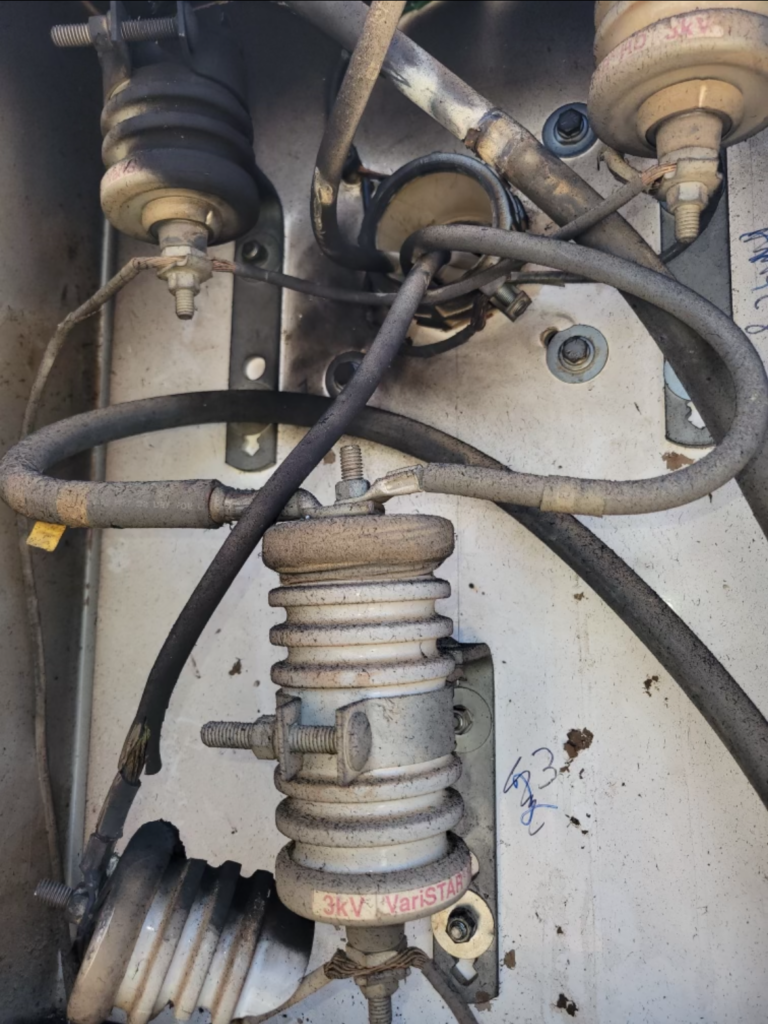
In those environments, controlled failure behavior becomes a critical design requirement.
The issue is not that lightning arresters are unsafe when properly applied. The issue is that failure behavior, physical placement, and protection objective must align with the application.
For Maxivolt WS Series applications, integrated overcurrent protection is used to provide controlled disconnection under abnormal or end-of-life conditions.
What Equipment-Level Protection Requires
Effective equipment-level protection requires a different design approach than system-level insulation coordination.
Protection should be evaluated based on:
- The voltage tolerance of the connected equipment
- The protective level of the mitigation device
- The location of the protection relative to the load
- The mode of protection
- The frequency of lower-magnitude events
- The failure behavior of the protective device
- The need for overcurrent isolation
- The installation environment
- The consequence of equipment malfunction or shutdown
For medium-voltage equipment, this becomes especially important because the protected system may include both high-energy power components and lower-withstand electronic components. A motor, drive, or control system may have insulation designed for one class of stress, while its embedded electronics have a much lower disruption or degradation threshold.
Effective equipment-level suppression should therefore be selected around the equipment being protected, not merely the voltage class of the distribution system.
The protection objective should be:
Limit transient overvoltage at the protected equipment to a level the equipment can tolerate reliably.
Coordinated Protection: Do Not Substitute One Layer for the Other
Lightning arresters and equipment-level SPDs should not be viewed as interchangeable.
They serve different roles.
Lightning arresters are appropriate for system-level insulation coordination. Equipment-level SPDs are appropriate for protecting specific loads from transient overvoltage exposure at the point of vulnerability.
A coordinated strategy may include both:
- Lightning arresters applied upstream for system insulation protection.
- Equipment-level transient voltage mitigation applied at or near the protected load.
- Protection selected around the actual withstand and sensitivity of the equipment.
- Controlled failure behavior appropriate for the installation environment.
- Consideration of both external and internally generated transient events.
- Placement and lead-length practices that limit the voltage the protected load actually sees.
This approach does not diminish the value of lightning arresters. It places them in their proper role.
The goal is not to choose between system protection and equipment protection. The goal is to apply each layer where it is effective.
Frequently Asked Questions
Don’t lightning arresters already protect against surges?
The answer is two-part and describes different problems.
Yes, lightning arresters are excellent system-level protection devices. They are designed to limit high-energy surge events to levels that coordinate with the insulation withstand of power-system components.
No, equipment-level protection is different. It focuses on the transient overvoltage that reaches motors, drives, controls, PLCs, sensors, and other electronic loads. Those loads are affected at voltage levels far below the insulation coordination levels used for system protection.
Can a lightning arrester work correctly and equipment still fail?
Yes. A lightning arrester can perform as designed by limiting a transient overvoltage to a level acceptable for system insulation. If that level is still above the tolerance of connected electronics or if the protection is not located close enough to the point of vulnerability, the arrester has fulfilled its system-level role while the equipment remains vulnerable.
Is BIL the correct protection target for electronics?
No. BIL is an insulation-withstand concept. It helps determine whether system insulation can survive an impulse event without breakdown or flashover. Electronic reliability is governed by much lower voltage thresholds, especially for solid-state components, control circuits, communication systems, and power supplies.
Is BIL the correct protection target for motors?
Not by itself. BIL helps define the motor’s overall insulation withstand capability, but it does not necessarily identify the most vulnerable part of the motor. Fast-front transient waves can produce localized voltage stress within the winding that is much higher than terminal measurements alone would suggest. Effective protection must be based on the voltage stress experienced by the winding, considering factors such as surge rise time, cable length, switching device characteristics, and winding voltage distribution.
Does a higher kA rating mean better equipment protection?
Not necessarily. A surge current rating describes what the protective device can survive under specified test conditions. Equipment protection depends on what voltage reaches the load during the event. A device can have a high surge current rating and still allow transient overvoltage levels that exceed the tolerance of sensitive equipment. Read a full article on kA ratings.
Why do internal transient overvoltages matter if lightning is more severe?
Lightning events can be severe, but many damaging or disruptive transient overvoltage events are generated by routine electrical activity. Motor switching, capacitor switching, VFD operation, contactor operation, reactor switching, and utility switching can produce lower-magnitude transient overvoltage events that occur more frequently.
These events may not threaten the system insulation, but repeated exposure can degrade electronics over time or cause intermittent malfunctions.
Can arresters and equipment-level SPDs be used together?
Yes. In many applications, that is the preferred approach. Lightning arresters protect the system insulation from severe external events. Equipment-level SPDs protect specific loads from transient overvoltage exposure at the point of vulnerability. The two layers should be coordinated, not treated as substitutes.
Why aren’t medium-voltage equipment-level protection devices always UL listed?
UL 1449 is a low-voltage surge protective device safety standard and does not provide a direct category for all medium-voltage equipment-level protection applications. This can lead to confusion and substitution with devices designed for different roles.
For medium-voltage applications, the protection strategy should be evaluated based on engineering suitability, equipment withstand, installation environment, protective level, failure behavior, and overcurrent isolation.
Conclusion
Lightning arresters play a critical role in protecting electrical distribution systems from high-energy external surge events. They are a necessary part of system-level insulation coordination.
But they are not the same as equipment-level protection.
A lightning arrester is designed to help the electrical distribution system survive. Equipment-level protection is designed to help the connected equipment operate reliably.
That distinction is especially important in modern medium-voltage applications where motors, drives, controls, PLCs, sensors, communication systems, and power supplies may be exposed to transient overvoltage levels far below the point of insulation breakdown or flashover.
The most reliable approach is not to substitute one protection layer for the other. It is to coordinate them.
Use lightning arresters where the objective is system insulation protection. Use equipment-level transient overvoltage mitigation where the objective is protecting the load.
A transient overvoltage can remain well below BIL and still exceed the tolerance of modern equipment. Protection strategies should be designed accordingly.
References
- IEEE C62.11, Standard for Metal-Oxide Surge Arresters for AC Power Circuits (>1 kV).
- IEEE C62.22, Guide for the Application of Metal-Oxide Surge Arresters.
- IEC 60099 Series, Surge Arresters.
- UL 1449, Standard for Surge Protective Devices.
- Electric Power Research Institute, Power Quality and Equipment Sensitivity Guidance, including EPRI Report 1000693.
- IEEE Std 1100, Recommended Practice for Powering and Grounding Electronic Equipment, commonly known as the Emerald Book.
- Nassar, O. M., “Effect of Surge Wave Reflection Inside a Motor on Voltage Distribution Across Stator Windings,” IEEE Transactions on Power Apparatus and Systems, Vol. PAS-104, No. 4, April 1985.
- Jayasree, V., Nanda, B., and Singh, B. P., “Transient Over Voltage Due to Switching Operation of Industrial Motor by Vacuum Circuit Breaker and Suppression of Surges,” International Journal of Science and Research, Vol. 3, Issue 9, September 2014.
- NFPA 780, Standard for the Installation of Lightning Protection Systems.
- U.S. Department of Energy, Solid-State Lighting R&D Opportunities, 2022.
